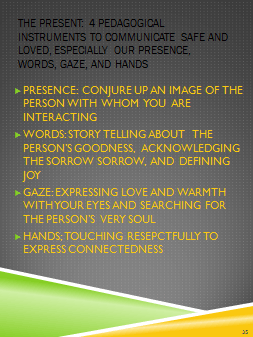
 How we come into contact with the most challenging individuals requires our total communication. For example, a man with schizophrenia who hears a wretched voice is like someone having a frequent nightmare while wide awake. This makes it harder to teach a person to feel safe and loved, but it also makes it more important that this be our central intention. His caregivers have to enter his space—softly, slowly, almost invisibly, with no rush and no pressure. The caregivers’ presence has to be tranquil and warm with no sense of any demand, not even a slight one. Indeed, the initial demand is our mere presence. Caregivers have to figure out their own way to present themselves without any pushiness. The caregiver’s words initially have to be whispered, sweet, and empathic—recognizing his sorrow, promising everything will be good, and ensuring him that no one is going to make him do anything. Our mere presence can be frightening enough. In time, our narrative of the person’s goodness grows and each momentary experience becomes longer and longer. The caregiver’s gaze should also be slow, carefully given, and momentarily looking into his eyes as if seeking to give warmth to his soul. Each gaze should be filled with love and empathy. In the beginning the caregivers’ touch might be the weakest of all the care giving tools since it could likely produce a deep fear and remembrance of years of physical management, restraint, and bossiness. When we feel safe, we might touch the top of his hand or his shoulder as a sign of love. These touches will then eventually grow into an embrace.


Breaking news

No comments!
There are no comments yet, but you can be first to comment this article.