

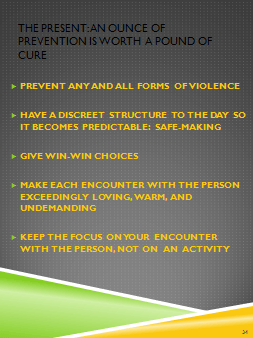
 Our first encounters with a marginalized person are often the most challenging because our mere presence can signal fear and terror, not because we are bad, but because we are simply one more caretaker in a long line of others. We are nothing more than someone just like all the rest—someone who bosses and orders around, grabs and pushes, ridicules and mocks, punishes and forbids, and where meanness replaces warmth.
It is ironic, but those who are violent are very emotionally fragile. We have a duty to protect a person with a life story of violence. It is crucial to prevent problems by avoiding even failure. When a person has lost his/her self-esteem, the person feels slammed to the floor and this further sucks out any confidence and the possibility of becoming grounded and connected with others. So, subtle protection is an important factor in the beginning of the process—even doing tasks for the person or with the person, preventing any degree of frustration, and giving answers to questions and then repeating the question.
Many cultures are so independence-oriented that any form of protection from harm is frowned upon. In a culture of gentleness we must keep our focus on nurturing and in the beginning this involves preventing just about any form of frustration and protecting the person from any physical or emotional harm.


No comments!
There are no comments yet, but you can be first to comment this article.