

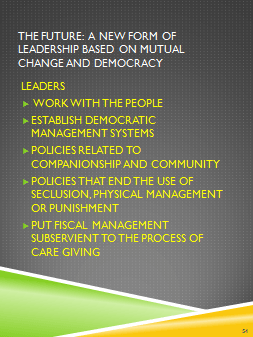
 The role of a servant leader is primarily to have clear non-violent and justice-based values and standards, to set a strong example in every aspect of her/his leadership, and to enter into an on-going dialog with the entire caring community. Of course, there is a myriad of other tasks, not the least of which is the fiduciary obligation of leadership. Yet, the latter tasks are at the center of leadership.
Today this role is increasingly important. There is a strong trend to employ a business model to human endeavors. This does not mean that we are against the business aspect of supportive service agencies. It is clear that we are all Good Shepherds and must watch over our resources. However, our more central duty is to provide support based on companionship and community-making. The role of advocates and caregivers is to make sure that this happens and that agencies do not devolve into mere money management and subservient to sometimes irrelevant or destructive rules and regulations. The fact is that a culture of gentleness cuts down on costly staff turnover, decreases bodily harm, and produces significant and meaningful outcomes.
This culture calls for the abolition of physical management and, thereby, reduce injuries and related liability costs. It calls for an increase in caregiver education and hands-on training and support and, thereby, reduce costly staff turnover. It calls for more personalized and in the here-and-now planning and, thereby, increases constructive outcomes.
Leaders should be frequently present with caregivers and those whom they serve setting a strong example of unconditional love.

No comments!
There are no comments yet, but you can be first to comment this article.