

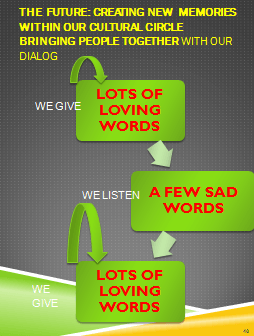
 The caregiving tool that is used (or misused) all the time is our words. Too often we speak boring behavioral talk about “good job,” verbal reprimands, or psycho-babble. We have to re-learn that our words should represent feelings of the person’s goodness, his/her sorrow, fears, and love. There are times when a person becomes so terrified that he/she becomes hallucinatory. These are moments when a nightmarish character might crawl into a person’s brain and take over and turn destructive. In time caregivers need to re-enter such a terrifying space slowly and reassuringly. Often it is best to let the person yell and then when he/she catches his/her breath simply insert a word or sound of consolation. Our words should be like warm embraces. Every sound is important. The tone and rhythm of our words are equal to the warmth and feeling of a loving embrace. Our words are as important as an embrace, perhaps more important. It is in the tone and rhythm that we find authenticity. It is in these that actual love and its meaning are found. Each part of our words must be like an embrace—warm, kind, and loving.
Listening is as important as talking. It is crucial, Our dialog’s authenticity is found within the sounds and the person listening communicates. Like us, with his/her entire being—the breathing, the softness of the face, the sparkle in the eyes, the fear, the joy, the surrender, the defiance. Our intention should not be to come up with moral lessons, but simply to listen with a deep sense of empathy and our response should be in our presence, eyes, hands, and words. In the beginning when anyone expresses existential sorrow our words might be summarized in a brief, but compassionate, phrase that simply expresses sorrow for the pain. Our overall communication should be a warm expression of love. We should not forget we speak in many ways—in our mere presence, our eyes, our touch, and our words.

No comments!
There are no comments yet, but you can be first to comment this article.