

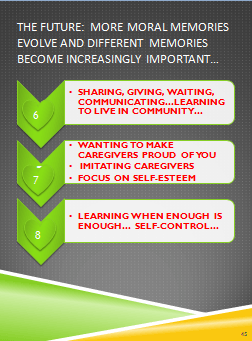
 Within these dimensions there are other moral milestones such as learning to share, a giving up, momentarily, of what is yours; learning to wait and to take turns; wanting others to be proud; and, learning when enough is enough—self-control. We all have to learn these milestones. Each requires a groundedness that we refer to as safe and loved. These phenomena are absolutely necessary for all further moral development.
At this stage we are teaching self-esteem and self-control. The person’s world begins to expand. After an intense dimension involved almost solely with unconditional love, it is natural to enter a phase of self-centeredness. It is then our role to stretch the person, carefully and delicately. It is a process in which the person learns or re-learns that it is good to be with a small circle of others, then it is good to do things with this group, and eventually it is good to do things for a circle of friends, and finally it is good to do things for others. This last encompasses a high form of moral maturity. We also begin to focus on the person’s self-esteem. This begins to occur from the very start when we are teaching that it is good to be together. As time goes on, we begin to notice that the person’s looks more warmly at us, his/her eyes have a sparkle, the face is more relaxed and soft, and the person holds his/her head up giving a sense of “I am somebody.” Self-esteem emerges out of our relationships. Self-control also begins to emerge, a sense of knowing when enough is enough and knowing and imposing boundaries on oneself. The caregiver begins to give win-win choices engaging with the person in more activities that require making choices that will avoid hurting anyone, but always ready to protect the person and others.

No comments!
There are no comments yet, but you can be first to comment this article.