

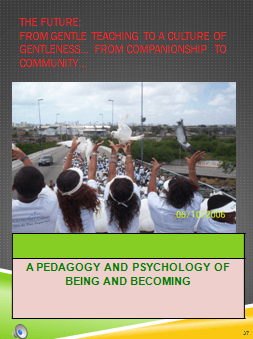
 If the most marginalized children and adults are to be well served in loving settings with a full spectrum of human rights, new assumptions must be asserted. These are philosophical in nature and call for an evolving collective embrace that highlights unconditional love as the central care giving and cultural phenomenon in serving others; a movement away from individualism and toward the creation of companionship and community as initial care-giving purposes; and, movement away from independence and toward interdependence. These involve:
- A focus on inner healing rather than behavioral change;
- A focus on the total acceptance of each person and forgiveness;
- Teaching each person and helping each to feel safe and loved;
- Helping persons learn to reach out lovingly, respectfully, and in a dignified manner toward others
- Helping others become as active a participant as possible in their own lives
- Entering into the person’s space without the provocation of fear and with the evocation of a sense of peace;
- Prevention of physical, developmental, and emotional harm; and,
- Creating a sense of companionship and community

No comments!
There are no comments yet, but you can be first to comment this article.